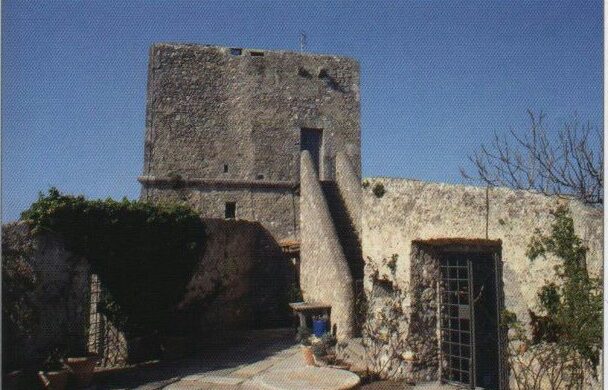
The Avvoltore tower, or more simply the Avvoltore tower, is located at the southeastern end of Mount Argentario, on the slopes of a promontory located a few kilometers southwest of Porto Ercole, accessible via the coastal scenic road.
The tower was built by the Aldobrandeschi during the Middle Ages as a strategic sighting point towards the south; subsequently, it became part of the Republic of Siena, continuing to perform its original functions. The Sienese in 1459 completely rebuilt the defensive structure, giving it its current fortified appearance.
From the second half of the sixteenth century the tower became one of the landmarks of the defensive system of the State of the Presidios; in 1566 the Spagnoli carried out a series of redevelopment and upgrading of the complex, to better integrate it into the more functional and modern coastal defensive device, in which it carried out effective sighting and signaling functions, being able to communicate visually with the Forte Stella est (the water tower was already abandoned) and with the Ciana tower to the west.
The tower was gradually abandoned from the first half of the nineteenth century, after the annexation of Monte Argentario to the Grand Duchy of Tuscany; its definitive closure and sale to private individuals took place after the unification of Italy.
The restorations carried out during the last century allowed to preserve the ancient coastal fortification in full.
The tower of the Avvoltore presents itself as a mighty quadrangular plan structure, with an imposing base with a cordoned shoe that together presents a truncated pyramid volume on which the upper part of the turriform building rests.
The access door opens on the mezzanine floor, in a right angular position, on one of the sides facing the ground; it can be reached via an external flight of stairs, originally equipped with a terminal drawbridge, later replaced by a fixed wooden one.
The external walls alternate some stretches covered in stone with others with a whitewashed plaster; a series of loopholes and some quadrangular windows open at different heights, although they correspond externally as a whole to the respective levels in which the complex is articulated. The upper part has no top crowns, although two protruding shelves are visible, which respectively concern the eastern and the southern sides.
The tower is surrounded as a whole by a series of high and thick curtain walls, also equipped with slots, which guaranteed a further safety device to the defensive structure delimiting it on the three sides facing the ground. Between the curtain walls of the external fort and the turriform building there is an annexed building, currently used as a residential building, which in the past was also used for military functions. The external protective fortress dates back to the redevelopment interventions carried out by the Spaniards in the second half of the sixteenth century.